Elbow
Muscle & Tendon
Evidence: suggestive
Hook Test Special Test
Orthopedic Physical Examination & Clinical Assessment Guide
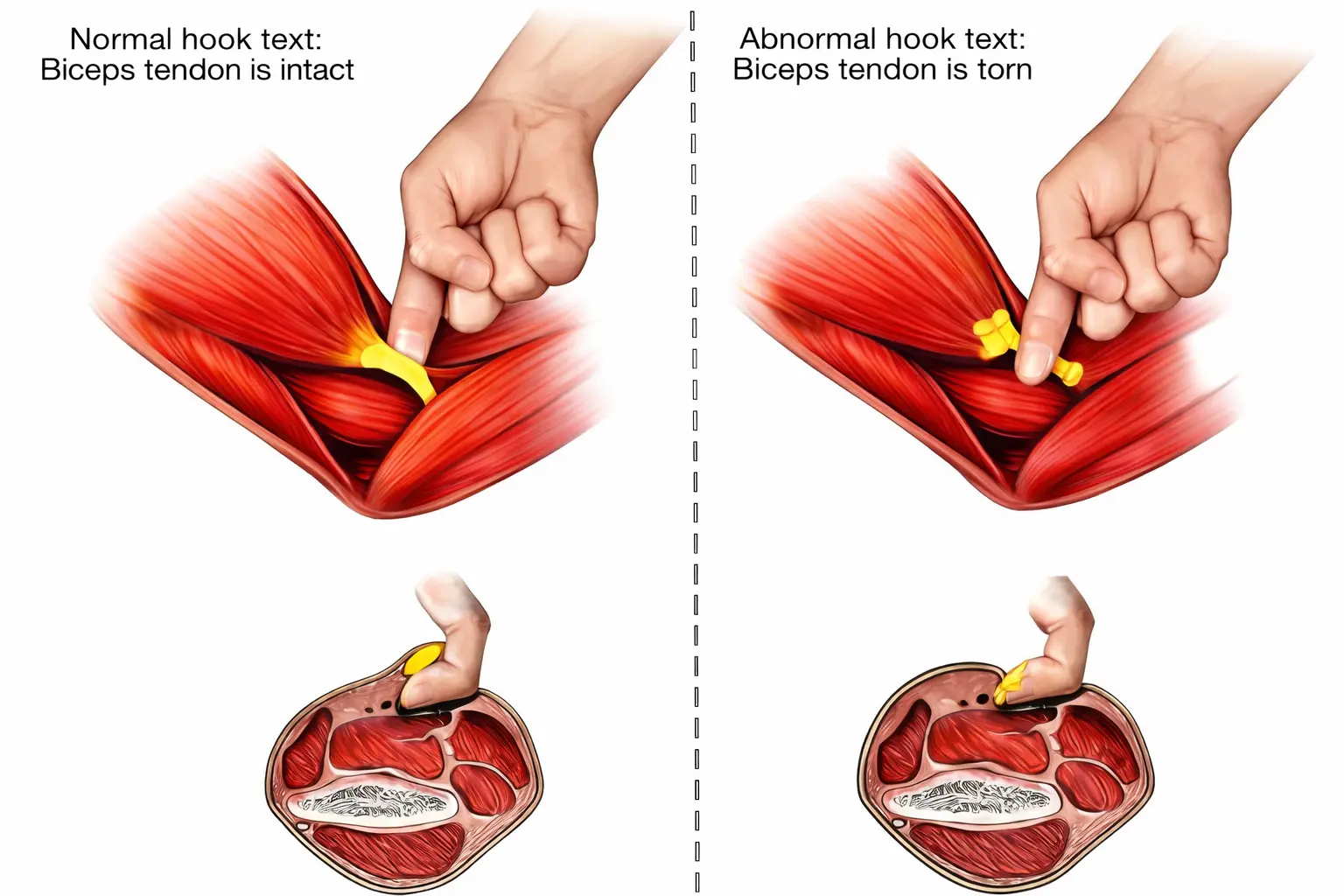
What is it used for?
- Diagnosing complete avulsion of the Distal Biceps Tendon.
How to Perform
- Position: Patient actively flexes the elbow to 90° and fully supinates the forearm (palm facing face).
- Action: Examiner attempts to 'hook' the index finger under the lateral edge of the biceps tendon in the elbow crease.
Interpretation of Results
- Normal: The finger can hook approximately 1 cm under the cord-like tendon.
- Positive (Rupture): No tendon is palpable; the finger cannot hook anything.
Diagnostic Accuracy
- Sensitivity: 100%
- Specificity: 100%
Clinical Context & Limitations
The Hook Test should be considered as one component of a comprehensive musculoskeletal assessment. No single special test has perfect diagnostic accuracy; thus, clinical decision-making should integrate test results with patient-reported symptoms, mechanism of injury, functional impairment, and relevant imaging.
Clinicians should be aware of potential false-positive results in patients with pain sensitisation, muscle guarding, or poor relaxation. For the Elbow region, combining the Hook Test with complementary examination tests significantly improves overall diagnostic confidence.
References
- Magee, D. J. (2021). Orthopedic Physical Assessment.
- Orthofixar | Hook Test